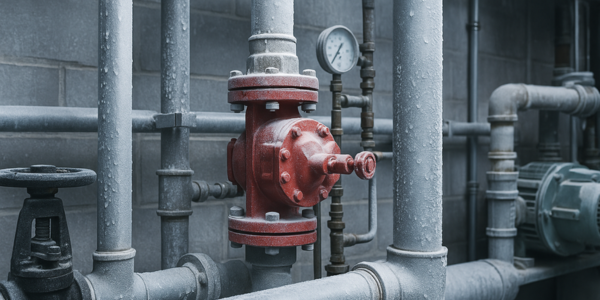
When temperatures drop, most facility teams keep an eye out for the obvious cold-weather threat: pipes freezing solid, but the real damage often happens long before a freeze-up. It starts quietly, in places you cannot see, as ice crystals form inside pipes and condensation collects on valves.
Small amounts of winter moisture are enough to weaken your fire protection system from the inside out. The effects are gradual and often invisible until a component fails under pressure or a critical device stops responding.
Read on as we explain how ice and condensation work their way through your system and why winter is the season that exposes these vulnerabilities the most.
The Hidden Process That Creates Big Problems
Fire protection systems constantly move between warm interior air and cold exterior conditions. Every time a loading dock door opens, or a mechanical room temperature dips, that swing creates condensation. Over time, that moisture becomes a catalyst for deterioration.
You may not see the impact immediately, but months later it shows up in the form of corrosion and fractures. By then, the damage is already done.
Here’s what winter moisture is doing behind the scenes.
1. Corrosion Inside Sprinkler Piping
Every dry or pre-action system naturally introduces air into the pipe. Add condensation, and that air becomes the perfect mix for corrosion.
What starts as a thin film of moisture becomes:
- Pitting that thins the pipe walls
- Flakes of corrosion that restrict water flow
- Scale that blocks branch lines
- Unexpected leaks during routine tests
Cold temperatures accelerate this cycle, especially in unheated spaces. Most corrosion issues facility managers discover in spring began with winter condensation.
2. Pipe Fractures Caused by Freeze Expansion
It only takes a small amount of water to fracture a pipe. Even a puddle trapped in a low point can freeze, expand, and apply enough pressure to crack fittings, couplings, or the pipe itself.
These fractures often hide until the system recharges. The pipe holds during cold weather, but the moment water flows, it bursts.
High-risk areas include:
- Stairwells and elevator shafts
- Exterior walls
- Loading docks
- Mechanical rooms with inconsistent heat
- Attics and ceiling voids
This type of failure is one of the most common winter service calls.
3. Ventilation Weakens Over Time
Most people don’t think of electrical fire alarm equipment as vulnerable to winter. But cold spaces produce condensation inside conduit, cabinets, and junction boxes, especially when warm air meets cold metal surfaces.
The results can be serious:
- Short circuits
- Ground faults
- Repeated nuisance alarms
- Panel communication issues
- Total shutdown of monitoring equipment
A single droplet of moisture on a control board can compromise the entire system.
4. Detector Malfunctions Caused by Moisture Exposure
Detectors are engineered for controlled environments. Winter creates the exact opposite: cold air, warm air, rapid swings, and high humidity in specific areas.
This leads to:
- Detectors going into alarm from moisture droplets
- Sensors becoming overly sensitive
- Premature device failure
- Degraded performance over time
Duct detectors are especially vulnerable because cold exterior air mixes with warm indoor air inside the ductwork, creating condensation directly on the sensing mechanism.
How Facilities Can Prevent Winter Moisture Damage
The good news is that winter moisture problems are predictable and preventable with the right steps.
Stabilize temperatures in all mechanical areas.
A consistent environment reduces moisture formation.
Insulate exposed piping and valves.
Insulation prevents frost, condensation, and freeze expansion.
Drain low points frequently.
Moisture collects here first. Removing it is one of the simplest ways to prevent corrosion.
Perform internal inspections of dry and pre-action systems.
Camera inspections can reveal early corrosion before it leads to a failure.
Protect fire alarm equipment from temperature swings.
Ensure panels, modules, and conduit are sealed and shielded from cold air infiltration.
Schedule a winter readiness assessment.
A proactive inspection can catch small issues before they become costly repairs.
Stay Ahead of Winter Damage with Ward Fire Protection
Winter moisture damage rarely announces itself. It builds silently until there is a leak, a failed detector, or an unexpected alarm at the worst possible time. That’s why a proactive approach is essential.
Protect your building before deep winter sets in. Contact Ward to schedule your winter system assessment.